Online reputation can influence whether people trust a business, apply for a job, contact a professional, or choose one company over another. And increasingly, reputation is shaped by more than traditional reviews. Google search results, social media, AI-generated content, online communities, public records, and third-party websites can all influence how a person or organization is perceived online.
The following reputation management statistics show how consumers, employers, and other audiences research and evaluate people and businesses online in 2026.
Read more for key data and statistics in online reputation management.
In an MIT study, participants were only 3% less likely to believe a false tweet when it was human-written rather than AI-written.
Source: MIT Technology Review
1. Online Reputation and Consumer Reviews
Reviews remain one of the most important sources of information consumers use when evaluating a business.
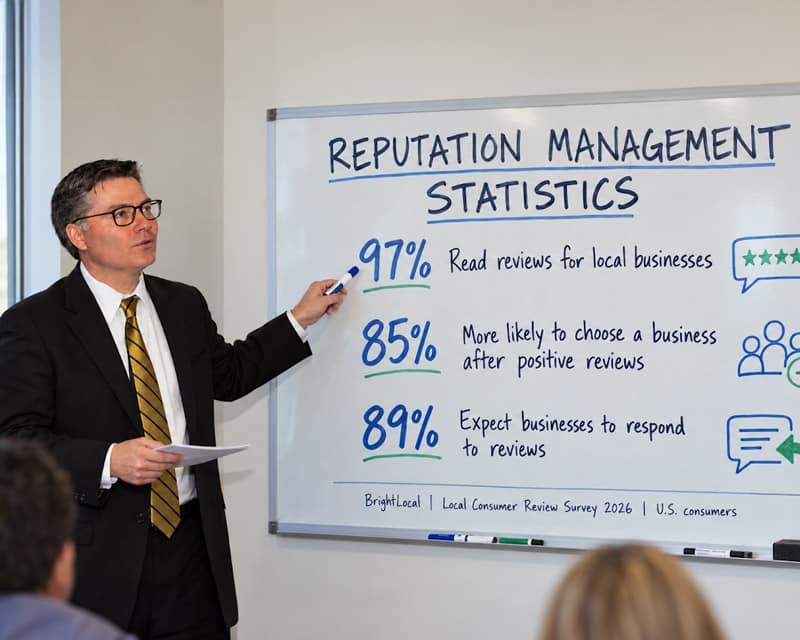
97% of consumers rely on reviews when making purchasing decisions
Reviews can serve as social proof before a prospective customer ever contacts a company. A strong collection of recent, credible reviews can help establish trust, while negative or suspicious reviews can raise questions about a business.
Source: BrightLocal
47% of consumers won't use a business with fewer than 20 reviews
Review volume can matter alongside average star ratings. A business with a handful of reviews may provide less evidence of consistent customer experiences than one with a larger, established review history.
Source: BrightLocal
31% of consumers only use businesses with a 4.5-star rating or higher
For consumers who use star ratings as an initial screening tool, even relatively small differences in average ratings can affect which businesses make their consideration set.
Source: BrightLocal
More than 90% of consumers say positive reviews make them more likely to use a business
Positive reviews can reinforce trust at the point when a prospective customer is deciding whether to take the next step.
Source: Status Labs
86% of consumers trust online reviews as much as personal recommendations
This illustrates how reviews have become a form of digital word-of-mouth. A review from another customer can provide information that a company's own marketing materials cannot.
Source: Status Labs
0%
5%
10%
A 1-star increase in Yelp rating was associated with a 5% to 9% increase in revenue
Harvard Business School research examining Yelp ratings found an association between a one-star increase in rating and a 5% to 9% increase in revenue for the businesses studied.
Source: Harvard Business School
What the data shows: Reviews aren't simply a customer-service issue. They can influence how consumers discover, evaluate, and choose businesses.
Positive and negative reviews both matter
Reputation management isn't simply about collecting as many five-star reviews as possible.
Consumers also look for detailed, credible feedback. Negative reviews can provide useful information about potential problems, while an unusual absence of negative feedback can sometimes raise questions about authenticity.
Effective review management involves monitoring what customers are saying, responding appropriately to legitimate criticism, identifying potentially fraudulent content, and making it easy for satisfied customers to share genuine experiences.
2. AI and Disinformation Are Changing Online Reputation
Artificial intelligence is creating new challenges for reputation management. Content can now be generated, modified, and distributed at a scale that was difficult to achieve only a few years ago.
AI-written
human-written
People can be nearly as likely to believe AI-generated misinformation
In an MIT study, participants were only 3% less likely to believe a false tweet when it was human-written rather than AI-written.
The finding illustrates a broader reputation risk: audiences may not always be able to distinguish between authentic information and content generated or manipulated by AI.
Source: MIT Technology Review
38.2% of Americans admit they've accidentally shared fake news
The spread of misinformation isn't necessarily intentional. People can share inaccurate information because they believe it is legitimate, don't verify the original source, or encounter content that appears credible.
Source: Statista
54% of Americans use social media and video platforms as a source of news
When social platforms become information sources, posts and videos about businesses, executives, and other individuals can reach audiences well beyond their original followers.
Source: Reuters Institute
Only 15% of people are "very confident" in their ability to spot fake news
This creates an environment in which inaccurate information can potentially be mistaken for legitimate reporting or commentary.
Source: Statista
42% of companies use AI to scan candidates' online presence
AI isn't only changing how content is created. It's also changing how people are evaluated. One survey found that 42% of companies use AI to scan a candidate's social media or personal websites as part of hiring.
Source: ResumeBuilder.com
What the data shows: AI can affect reputation from both directions. It can make misleading content easier to create while also making it easier for organizations to analyze someone’s digital footprint.
AI creates a new reputation-management challenge
Reputation monitoring increasingly involves more than checking what people publish. It can also mean monitoring how information is summarized, repeated, and surfaced by technology.
Potential areas to monitor include:
AI-generated content
Inaccurate summaries
Misleading social media posts
Fake profiles
Manipulated images or videos
False reviews
Misinformation appearing in search results
Inaccurate information repeated across multiple websites
As AI-powered search and answer engines become another way people discover information, maintaining accurate and authoritative information online becomes increasingly important.
3. Google Search Is Part of Your Reputation
For many people, Google is the starting point for researching a business, executive, professional, or organization.
Only 0.63% of Google searchers clicked on a result from the second page
A widely cited Backlinko analysis found that just 0.63% of Google searchers clicked on a result from the second page.
The implication for reputation management is straightforward: visibility matters.
If someone searches for your company or name, the information appearing near the top of the results may receive substantially more attention than information several pages deeper.
Source: Backlinko
What can appear in a branded search?
Someone searching for a company or individual may encounter:
Company websites
Review profiles
News articles
Social media profiles
Reddit discussions
Forum posts
Public records
Directory listings
Videos
Blog posts
Negative or inaccurate content
Why search position matters for reputation
A positive article buried several pages into search results may have limited visibility if a negative article, review, or discussion appears prominently on page one.
That's why reputation management can involve more than attempting to remove negative content. It can also involve developing and maintaining accurate, authoritative, and relevant content that helps establish a stronger online presence.
What the data shows: A reputation isn't just about what information exists online. It's also about what information people are likely to see.
5. Online Reputation Can Affect Hiring
Reputation isn't only important for attracting customers. It can also affect employment decisions.
Employers research candidates online, while prospective employees research companies before applying and accepting offers.
70% of employers use social media to research candidates
A candidate's online presence can become part of an employer's overall impression before an interview takes place.
Source: CareerBuilder
57% of employers are less likely to interview candidates they can't find online
Having little or no online presence can itself raise questions for some employers.
Source: PR Newswire
70% of employers check applicant profiles
Social media can therefore become part of the informal screening process in addition to a traditional résumé and application.
Source: Harvard Business Review
54% of employers have rejected a candidate based on what they found online
Research cited by Harvard Business Review found that more than half of employers who screened candidates through social media had rejected someone based on what they discovered.
Source: Harvard Business Review
95% of Gen Z applicants say a company's social media presence affects their decision to apply
Reputation works in both directions. Employers evaluate candidates, but candidates also evaluate employers.
Source: Zety
What the data shows: Online reputation can influence both sides of the hiring relationship.
Job seekers may research:
Company reviews
Employee experiences
Leadership
Social media activity
News coverage
Company culture
Online complaints
Public controversies
6. Executive and Corporate Reputation
For executives, founders, and other highly visible leaders, personal and corporate reputation can become closely connected.
Executives attribute 63% of company market value to reputation
Weber Shandwick research found that global executives attributed 63% of their company's market value to its overall reputation.
Source: Weber Shandwick
Executives can become associated with their organizations through:
Search results
News coverage
LinkedIn profiles
Interviews
Social media
Public statements
Industry publications
Speaking appearances
Executive reputation management isn't necessarily about creating a polished personal image. It can also involve making sure accurate information about a leader is available and that professional accomplishments, expertise, and company information are properly represented online.
7. Fake Reviews Are a Reputation Management Problem
Fake reviews can undermine trust because consumers don't always know whether a review represents a genuine customer experience.
10.7%
Yelp
7.1%
Tripadvisor
5.2%
4.9%
0% 3% 6% 9% 12%
Google had a reported 10.7% inauthentic-review rate
One study cited by Agility PR found an estimated 10.7% inauthentic-review rate on Google, compared with:
7.1% on Yelp
5.2% on Tripadvisor
4.9% on Facebook
Source: Agility PR
74% of consumers can't always tell a fake review from a real one
Research has found that 74% of consumers admit they cannot always distinguish a genuine review from a fake one simply by reading it.
Source: WiserNotify
Potential warning signs of fake reviews include:
Unusually extreme language
Generic or repetitive wording
Poor grammar
Lack of specific details
Suspicious reviewer profiles
Large numbers of reviews posted within a short period
Reviews that don't appear consistent with the customer's experience
Reputation management isn't about manufacturing positive reviews
Businesses should focus on building a credible review profile rather than simply maximizing their star rating.
That means:
Encouraging genuine customers to leave reviews.
Responding professionally to legitimate negative feedback.
Monitoring for potentially fraudulent reviews.
Reporting reviews that violate platform policies.
Avoiding fake or incentivized reviews.
Using customer feedback to identify recurring problems.
What the data shows: Review credibility matters alongside review volume and rating.
8. Privacy Is Part of Personal Reputation Management
For individuals, online reputation management can also mean controlling how much personal information is publicly available.
People-search websites, data brokers, public records, social profiles, and other databases can expose information that individuals may not want broadly available.
92% of Americans are concerned about online data privacy
Privacy concerns have remained widespread as more personal information becomes available through online services and databases.
Source: TrustArc
85% of adults globally want to do more to protect their online privacy
The desire for greater privacy extends beyond the United States.
Source: Exploding Topics
55% believe complete privacy protection is impossible
For many people, protecting personal information isn't simply a matter of changing a few privacy settings. Information can exist across numerous websites and databases.
Source: Exploding Topics
540 registered data brokers were identified in the United States
The Privacy Rights Clearinghouse identified 540 registered data brokers in the U.S. in its 2021 research.
Source: Privacy Rights Clearinghouse
What the data shows: Personal reputation management and privacy management increasingly overlap.
Removing personal information from the internet isn't always simple. Information can be duplicated across websites, republished by other sources, or contained in records subject to different rules.
Personal reputation management can therefore include identifying where information appears, requesting removal where appropriate, and monitoring whether information reappears.
What These Reputation Management Statistics Tell Us
The numbers tell a broader story about how reputation works online in 2026.
Reviews remain a major source of trust and social proof.
Where information appears in search can significantly affect its visibility.
Social platforms have become important channels for discovering and sharing information.
Online reputation can influence professional opportunities as well as consumer decisions.
Corporate reputation can extend beyond products and services to the broader perception of an organization.
Review authenticity is increasingly important as consumers encounter more online feedback.
Privacy and personal reputation are becoming increasingly interconnected.
10. Reputation Management Requires an Ongoing Strategy
The statistics point to one common theme: online reputation is distributed across the internet.
It can be influenced by a Google search result, a one-star review, a Reddit discussion, a LinkedIn profile, a news article, an old social media post, a people-search website, or even information generated or summarized by AI.
Managing that reputation can involve:
Monitoring search results
Managing business reviews
Responding to legitimate criticism
Identifying potentially fraudulent content
Addressing inaccurate information
Maintaining professional social profiles
Protecting personal information
Building authoritative online content
Monitoring how information about a person or business changes over time
The goal isn't necessarily to eliminate every negative comment or prevent anyone from saying something unfavorable. Effective reputation management focuses on understanding what information is available, addressing legitimate problems, correcting inaccurate information where possible, and ensuring accurate information is represented prominently online.
Need Help Managing Your Online Reputation?
Reputation911 helps individuals and organizations monitor and manage their online presence across search engines, review platforms, social media, and other online sources.
Whether you're dealing with negative search results, unwanted personal information, fraudulent reviews, or a broader online reputation challenge, understanding what people find when they search for you is the first step.


4. Social Media Has Become a Reputation Channel
A company's reputation doesn't live exclusively on its website.
Consumers, employees, journalists, investors, and other audiences can encounter a person or organization through social networks and online communities.
LinkedIn has more than 1 billion registered members
LinkedIn has become an important source of professional information about companies, executives, employees, and job candidates.
Source: 99firms
Instagram has billions of monthly users
For consumer-facing businesses, an Instagram profile can be one of the first places prospective customers encounter a brand.
Source: Statista
Reddit has hundreds of millions of users
Reddit and other online communities can become important sources of unsolicited discussions about companies, products, services, and individuals.
Source: DemandSage
76% of internet users participate in an online community
Online communities include blogs, forums, and other digital spaces where users share information and opinions.
Source: Social.plus
What the data shows: Reputation monitoring can't necessarily stop with Google and traditional review websites.
Depending on the individual or organization, relevant reputation channels can include:
LinkedIn
Instagram
Facebook
YouTube
Reddit
Quora
Industry forums
Community websites
News publications
Business directories
People can form opinions based on information published on platforms that the person or business doesn't directly control.