



When unwanted content appears online, it can feel overwhelming and frustrating. It can affect your personal reputation, professional opportunities, or the way others view yourself. The good news is that there are strategies available to help manage the impact and regain control of your online presence.
Content removal and search engine suppression are two important online reputation management strategies used to address harmful, outdated, or unwanted information. While both can help reduce the impact of negative content, they work in different ways.
Understanding the difference between these approaches can help determine the right strategy for protecting and improving your online reputation.
The Differences Between Content Removal and Search Suppression
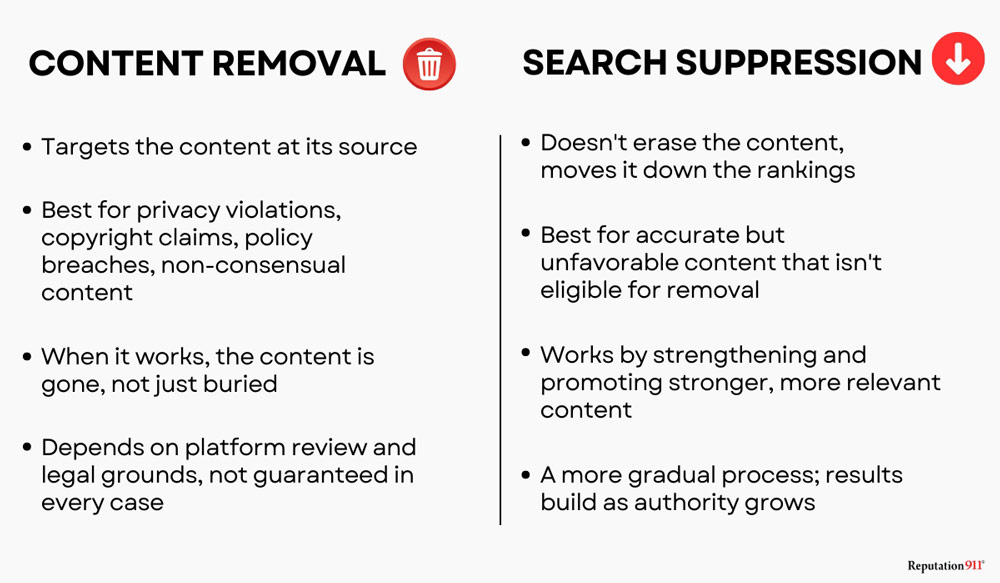
At a high level, content removal and search suppression are different methods of addressing negative content that exist online. Removal eliminates harmful content when possible, while search engine suppression reduces its visibility by promoting more accurate and positive information in search results.
What is Content Removal?
Content removal is the process of getting unwanted, harmful, outdated, or inaccurate information removed across websites, search engines, social media platforms, or other online sources.
When most people think of content removal, they typically mean removing of unwanted content across the internet. However, it may also be referring to the removal of content from a specific platform, such as Google or another search engine. In these cases, the content may still exist at its original source, but it is removed from, or made inaccessible, through the specific platform, preventing it from appearing in search results or being seen there.
What is Search Engine Suppression?
Search engine suppression is the process of reducing the visibility of unwanted, negative, or harmful content in search engine results by promoting more accurate, positive, and relevant content to push those results lower in the rankings.
Unlike content removal, which focuses on completely deleting information from a website or platform, suppression focuses on pushing unwanted search results lower in the rankings on traditional search engines, effectively burying negative content beyond the first page of results. The content is not removed entirely, but it becomes significantly less visible and harder for others to find.
Comparing Content Removal and Search Engine Suppression
Content removal and search engine suppression are often used together as part of a broader online reputation management strategy. While both approaches can help reduce the impact of unwanted information online, they work in fundamentally different ways. Here’s how many cases are approached:
- Remove what can be removed: The first step is identifying content that violates policies, privacy rights, or legal standards and submitting removal requests.
- Suppress what cannot be removed: If content remains online, suppression strategies help reduce its visibility by strengthening positive, authoritative content.
- Build a stronger digital presence: Long-term reputation protection involves creating and optimizing content that accurately represents a person, business, or brand.
However, the ordering of this may change depending on your situation. The more effective strategy to use can depend on a few things:
- The type of content: Different types of content may have different removal options or eligibility requirements.
- Where the content appears: Removing information from its original website is different from removing or de-indexing a result from a search engine.
- Whether the content violates a policy or legal standard: Some content may qualify for removal, while other content may remain online even when it is inaccurate, unfavorable, or damaging.
- The content’s current search visibility: Highly visible results may require a more active suppression strategy to move them away from the first page.
- The strength of the existing online presence: A person or brand with a well-established digital footprint may have more opportunities to promote authoritative content and influence search results.
- The long-term reputation goals: In some cases, addressing a single piece of content may be sufficient. In others, ongoing content development and search optimization may be necessary to strengthen the overall online presence.
In many cases, the most effective online reputation management strategy combines both approaches: remove content when there is a legitimate basis for doing so, suppress what remains, and build a stronger digital presence over time.
The Best Strategy May Depend On the Likelihood of Content Removal
The right reputation management strategy often depends on whether the unwanted content can realistically be removed. While content removal is the ideal outcome, not all content qualifies for removal. Website owners, publishers, and platforms typically have specific policies and legal requirements that determine whether a request will be approved.
When content violates privacy rights, platform guidelines, copyright laws, or other regulations, content removal may be the most effective approach. Removing the source eliminates the content itself rather than simply reducing its visibility.
However, some harmful content may remain online even when it negatively affects a person or brand. For example, accurate but negative news articles, public records, or opinions that do not violate platform policies are often difficult to remove. In these situations, search engine suppression may be the better strategy to reduce visibility and promote more accurate, positive information.
| Likelihood of Content Removal | Common Examples | Recommended Strategy |
| High Likelihood |
|
Pursue content removal to eliminate the source |
| Moderate Likelihood |
|
Request removal while preparing suppression strategies if needed |
| Low Likelihood |
|
Focus on search engine suppression and reputation improvement |
| Not Eligible for Removal |
|
Build positive content and improve search visibility |
Ultimately, the most effective approach is determined by both the type of content and the probability that it can be removed. When removal is possible, eliminating the source is usually the first priority.
If removal is unlikely, suppression strategies can help ensure that accurate, relevant, and positive information becomes more visible in search results.
A Reputation Management Professional Helps Create the Right Plan for You
At Reputation911, our approach to deciding between content removal and suppression starts with taking the time to understand your situation, your current online reputation, where your content is appearing.
Every situation is different, and the right strategy depends on outside factors that we may have limited control over, such as platform policies, legal considerations, and content ownership. However, there are strategies that are proven to help remove content, including platform violations, and legal strategies taken.
If you need help managing your online reputation, contact us. We provide professional content removal services to help identify and address content that may qualify for removal. When content cannot be removed, our Google search suppression services can help reduce its visibility by promoting more positive, accurate, and relevant information, protecting and strengthening your online image.
Our end goal is to completely restore your reputation quickly and fully, across the internet.