


A+ BBB Rating

5/5 Rating

5/5 Rating
 Grady DiAntonio
Finding out your private photos are online, visible to everyone, possible spreading, is one of the worst feelings imaginable. The shame, the panic, the helplessness. Maybe you’ve been staring at the screen, shaking, not knowing where to start.
You’re not alone, and you’re not powerless.
This guide will walk you through exactly what to do when you find out your nudes have been leaked, including how to remove leaked photos online.
Take These Steps As Soon As You Discover Your Leaked Pictures:
From May 19th, 2026, websites, apps, and social media platforms in the US will have to start complying with the TAKE IT DOWN Act.
A threat to leak your photos is more than cruel; it’s a crime.
This is called sextorsion, a form of online blackmail, where someone threatens to release your intimate images unless you give them what they want–whether that’s money, more photos, or something else. It can happen on dating apps, social media, WhatsApp, over text, and plenty of other platforms.
And, it’s more common than you might think. In one study, 14.5% of people surveyed said they were the victim of a sextorsion attack.

If you’re in this situation, here’s what to do:
Don’t pay or give them anything. Complying will not make things stop. It just tells them that their tactics work, and they’ll keep pushing.
Before you block them, save everything. Screenshot their profile, username, and every single message. This evidence is key for reporting and for any legal action down the road.
Block them and report them to the platform. Every major social media platform, dating app, and messaging service has an abuse reporting platform.
Get help with removal now, don’t wait. The NCMEC Take It Down program and the Cyber Civil Rights Safety Center both offer free resources for victims. A professional reputation management company can also handle takedown quickly if the images have already been posted or you suspect they will be.
Report it. Contact your local law enforcement, or file a complaint with the FBI’s Internet Crime Complaint Center (IC3). Sextorsion cases are taken seriously, and early reporting strengthens your case.
Yes, sharing someone’s intimate images without their consent is illegal. Depending on where you are and how it happened, the perpetrator could face criminal charges, fines, and prison time.

As of May 2025, when South Caroline became the final holdout, all 50 states now have criminal laws covering the non-consensual distribution of images (NDII). No matter where you live in the U.S., what happened to you is illegal.
But the laws aren’t identical across every state.
Deepfakes are a patchwork. Nearly all states have laws prohibiting deepfake pornography, but they vary in their penalties and what prosecutors need to prove. Some require evidence the perpetrator intended to cause financial or emotional harm.
Sextorsion specifically isn’t named in every state statute, but that doesn’t mean the perpetrator is off the hook. Extortion and blackmail are illegal in all 50 states. Threatening to release intimate images to extract money or favors will almost certainly fall under those laws regardless.
You can check the specific laws in your state at the Cyber Civil Rights Initiative.
The TAKE IT DOWN Act was signed into law on May 19, 2025–creating a new federal crime for “knowingly publishing” or threatening to publish intimate images without a person’s consent, including AI-created deepfakes. Its full name is the Tools to Address Known Exploitation by Immobilizing Technological Deepfakes on Websites and Networks Act.
Here’s what the act does:
✅Online platforms are now required (as of May 19, 2026) to remove non-consensual intimate imagery within 48 hours of receiving a report–enforced by the Federal Trade Commission (FTC).
✅Criminal penalties include up to two years imprisonment for offenses involving adults, and three years when minors are involved.
✅The law explicitly includes deepfakes and AI-generated images of real, identifiable people. So, even if your state laws don’t address this, federal law does.
❗Because the law is so new, we’re still yet to see exactly how and to what extent it will be enforced. You can read the full Senate bill here.
If you’re based in the UK or EU, you have additional legal protections that go beyond what’s available in the U.S.
In the UK, amendments to the Sexual Offenses Act 2003 that took effect in February 2024 criminalize both sharing intimate images without consent and threatening to share them.
Under GDPR, your photos are considered personal data. This gives you the right to demand their removal from platforms and, in certain circumstances, from search engine results entirely. This is known as the “Right to Be Forgotton,” and you can submit a request to Google here.
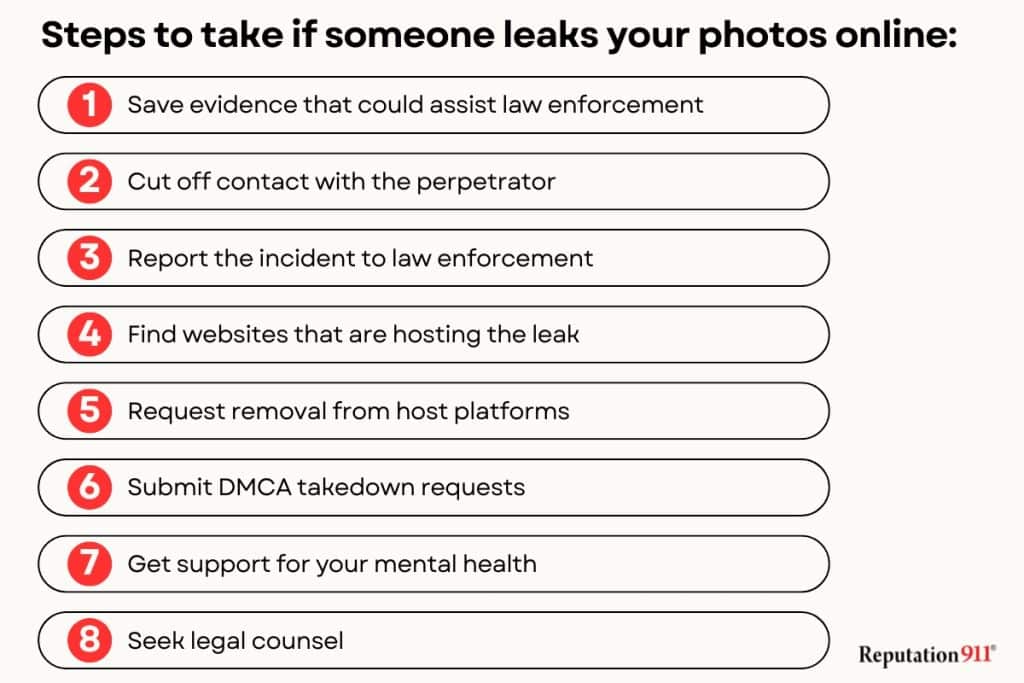
Document as much as you can before anything disappears:
Keep it all in one place. You’ll need it for police reports, takedown requests, and potentially legal action.
Once you’ve saved everything, do not respond to them. Engaging can escalate the situation and may undermine your legal case. Block them on every platform they’ve contacted you through, then report them.
Contact your local law enforcement and tell them what happened. Bring everything you’ve documented. Remember, even if the images haven’t been posted yet, a threat to leak them is already a crime.
Once private images are out there, they can spread fast. What started on one site may already exist on five others. Before you can begin removing leaked images, you need to know the full extent of it before you can start removing anything.
Here’s how to find where your images are:
Search your name in Google Incognito mode. Try variations too–nicknames, usernames, any name someone might associate with you.

Run a reverse image search. Tools like Google Lens, TinEye, and PimEyes can find copies of a specific photo across the web, even if your name isn’t attached to it.

Paste every URL into a document. This serves two purposes: it’s evidence, and it becomes your removal checklist so nothing slips through the cracks.
If you or the victim were under 18 in any of the images, do not screenshot, download, or reverse image search them.
Simply note the URLs of where they appear. Then take these steps:
Send a direct request to every website hosting your private content to remove the leaked image. Here’s how to approach it:
Find their contact details. Look for a “Contact,” “Report,” or “Legal” page on the site. If nothing comes up, use a WHOIS lookup tool to identify the site’s host or administrator.

Send a formal removal request. Via email or contact form. Be clear, direct, and firm–the content was uploaded without your consent and violates your privacy rights.
Provide limited proof of ownership. If they ask for verification, never send the full image. Some platforms may ask for a government-issued ID. Only provide this to legitimate sites with clear privacy policies, and redact everything except your name and photo.
Follow up if you don’t hear back within a week.
Escalate unresolved cases. If the site owner doesn’t respond, go above them to the web host (BlueHost, GoDaddy, Cloudflare, etc). At this point you may want to file a DMCA or seek an attorney’s help.
Not all platforms are created equal when it comes to compliance. Here’s a realistic picture of what you’re dealing with:
|
Type
|
Example
|
Difficulty
|
|---|---|---|
|
Mainstream Adult Sites
|
Pornhub
|
Easy. Highly responsive to takedown requests, typically actioned within days.
|
|
Offshore Adult Sites
|
Erome.com
|
Easy to Moderate. Generally responsive, though processes vary by jurisdiction.
|
|
Social Media Platforms
|
X.com (and similar)
|
Moderate Slow and inconsistent enforcement, often require ID or contracts, and may deny clear policy violations.
|
|
Paywalled Leak Forums
|
LeakedBB.com, Statewins.pk
|
Moderate to Difficult. Require verification such as redacted ID or a domain email address for DMCA enforcement.
|
A DMCA (Digital Millenium Copyright Act) notice is a formal request demanding a website remove content that uses your intellectual property without permission.
If you took the photo yourself, it is automatically your intellectual property. You don’t need to register it anywhere. That ownership gives you the legal right to file these notices and compel websites to act.
If a site ignores a valid DMCA notice, they become legally liable for copyright infringement. Because website owners don’t want to risk any legal trouble, they’ll often just comply. Worth submitting even if you didn’t take the photo yourself.
Where to send them:

What happened to you isn’t just a practical problem to solve; it’s a violation. The emotional weight of the situation deserves attention. You might be experiencing feelings of shame, anxiety, and a sense of exposure. Having your images leaked online can take a real toll on your personal and professional relationships, as well as your confidence and mental health in general.
There’s no “correct” way to feel about this. Whatever you’re feeling, it doesn’t make you weak; it just means you’re human, going through an incredibly difficult situation.
If you’re not ready to talk to someone you know, that’s okay too. These resources exist to help you:
CCRI Crisis Helpline: 844-878-CCRI (2274)–available 24 hours a day, 7 days a week, with interpretation available in most languages. Staffed by compassionate representatives trained specifically in nonconsensual pornography, sextortion, and related abuse.
Crisis Text Line—text HOME to 741741 for free, confidential text-based support any time.
The National Domestic Violence Hotline — if this happened within an abusive relationship, call 800-799-SAFE (7233).
When you’re ready, don’t hesitate to find a therapist who specializes in sexual trauma or digital abuse. This isn’t something you have to push through on your own. Your recovery matters.
The steps we’ve outlined can take you a long way, but some situations call for a lawyer. An attorney can send legally binding cease and desist letters, pursue civil damages against the perpetrator, and apply pressure on platforms that are stalling.
Look for someone with experience in:
Removing an image from a website doesn’t mean it gets removed from search results right away. Search engines cache pages and can take weeks to catch up if something changes.
Use Google’s Remove Outdated Content tool to speed the process up. Here’s how:

Prevention isn’t foolproof, but these steps reduce your chances of exposure and give you an early warning system if something does happen.
Go to Google Alerts and create alerts for your name, username, and any variations. You’ll get an email every time your name appears in new search results, so you’ll find out faster if something surfaces.
StopNCII is a free tool that creates a unique digital fingerprint of your intimate images without you ever uploading them. That fingerprint gets shared with participating platforms so they can automatically detect and block the image if anyone tries to upload it.
Search engine suppression pushes unwanted results down in Google so they’re effectively invisible to anyone searching your name. The images may still exist online, but employers, colleagues, and anyone else googling you won’t find them. It gives you protection while you go through the removal process.
A photo leak is when someone distributes your personal images without your consent—typically intimate, explicit, or nude photos or videos. It can happen through hacking, unauthorized access to your device or cloud storage, or simply someone you once trusted choosing to share what you sent them privately.
If the person in the images is a minor, this is child sexual abuse material (CSAM) regardless of how the images were obtained or shared. That changes everything about how it should be handled.
Contact law enforcement immediately. This takes priority over platform takedowns or anything else in this guide. Bring every piece of evidence you have: URLs, messages, usernames, timestamps.
Deepfake pornography makes up 98% of all deepfake videos found online. You don’t have to have ever shared a nude picture for this to happen to you. Anyone who has a photo of your fac could make an explicit deepfake of you.
Thankfully, AI-generated intimate images are now explicitly covered under federal law by the TAKE IT DOWN Act. Signed May 2025, this law treats deepfakes exactly the same as real images–the person who created or shared it has committed a federal crime, and platforms must remove it.
The removal process is the same as for real images. Report it to the platform directly, and use Google’s removal tools to clear it from search results.
There are a few common ways it happens:
A trusted partner shares them without consent. This is the most common cause, and is typically referred to as revenge porn.
Screenshots on Snapchat and similar platforms. Disappearing messages don’t guarantee privacy. Once someone screenshots it, you lose control.
Hacking. Cybercriminals can access your phone or cloud storage directly, without you ever needing to send anything to anyone.
Unauthorized redistribution of paid content. If you’ve posted on OnlyFans or similar platforms, illegal downloading and reposting is common.
Remember that whatever the reason, image-based abuse is not your fault.

Most of the time, someone tells you. It might be a friend or stranger, but it’s often the perpetrator because they’re either blackmailing you or trying to cause emotional distress. Only about 12% of victims find the image themselves.
If you’re concerned, search your name in Google Incognito and run a reverse image search on any photos you’re worried about.


Seeing your leaked picture online is frightening. It affects your safety, privacy, personal life, and professional reputation. Thankfully, there are ways to remove these images from search results and reclaim control over how you’re seen online.