



An Oxford Internet Institute study found nearly 35,000 deepfake image generation tools available for public download on a single platform—downloaded almost 15 million times since late 2022. This isn’t a threat reserved for celebrities or corporate executives anymore. Anyone with a grudge and an internet connection can do this.
The financial damage is staggering. Deepfake-related fraud losses in the US reached $1.1 billion in 2025, with AI-powered deepfakes involved in more than 30% of high-impact corporate impersonation attacks. Incidents of deepfake fraud have surged 3,000% since 2022.
It works so well because 68% of deepfakes are now nearly indistinguishable from real media. People simply can’t tell anymore.
Then there’s voice cloning. It takes only three seconds of audio to replicate someone’s voice. If you’ve ever posted a video of yourself talking online, or a podcast, that audio is already out there. Over 53% of people share voice recordings online at least once a week, so most of us are unknowingly handing scammers exactly what they need.
These cloned voices are then used to call your family members pretending to be you in a fake emergency. Synthetic voice scams targeting family members in this way increased 45% in 2025. 77% of victims say they have lost money to these scams.
Here’s the big one. An analysis of nearly 15,000 deepfake videos found that 97% were nonconsensual intimate imagery, and 99% of those victims were women. Many victims are private individuals who had no idea a deepfake of them existed until the damage was already done.
Even when a deepfake is eventually exposed as fake, the reputational and emotional harm rarely disappears.
Deepfakes aren’t only a celebrity problem. The targets are wide-ranging, and so are the motives.
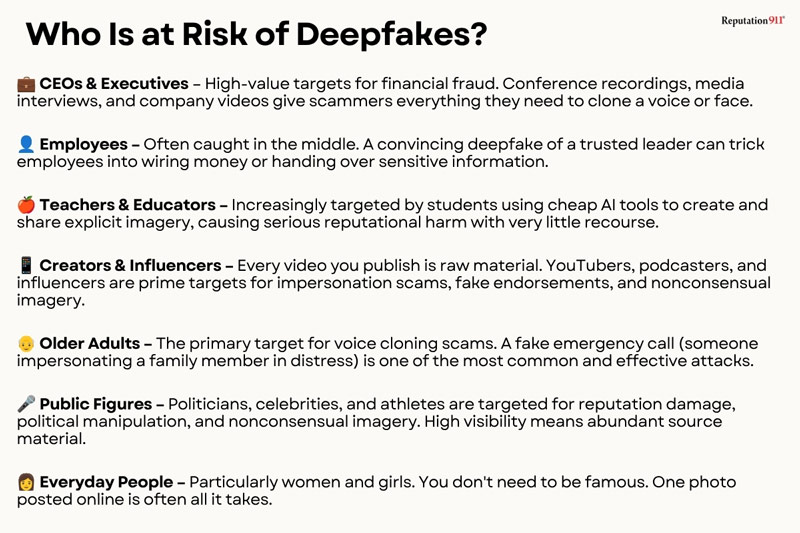
Deepfakes can be used in a variety of ways, ranging from scams and identity theft to entertainment and media manipulation.
Deepfakes can replicate someone’s voice or appearance to trick people into sending money, sharing personal information, or clicking malicious links. This includes phishing attempts, blackmail, and fake emergency calls–the most common being the “grandparent scam”, where a cloned voice impersonates a family member in crisis and pressures someone to wire money immediately. Three seconds of audio is all it takes for a scammer to pull this off.
Beyond outright scams, deepfakes are used to impersonate individuals to gain unauthorized access to accounts, bypass identity verification systems, or commit fraud under someone else’s name. This can happen to executives, employees, and everyday people alike.
A deepfake doesn’t need to involve money to cause serious harm. False or misleading content (a fabricated video of someone saying something offensive, or an audio clip designed to make them look incompetent or abusive) can spread rapidly and do lasting damage to a person’s career and personal life.
What makes this particularly insidious is that even after a deepfake is exposed and debunked, the reputational harm rarely disappears completely. People just remember what they saw first.
Not all deepfakes are malicious. Celebrities and public figures are sometimes the subject of satire, parody, visual effects, or dubbing created for entertainment purposes. The line between harmless and harmful, though, can be thin–and consent is rarely part of the conversation.
Staying cautious online and verifying suspicious content can help reduce the risk of falling victim to deepfakes and other AI-generated scams.
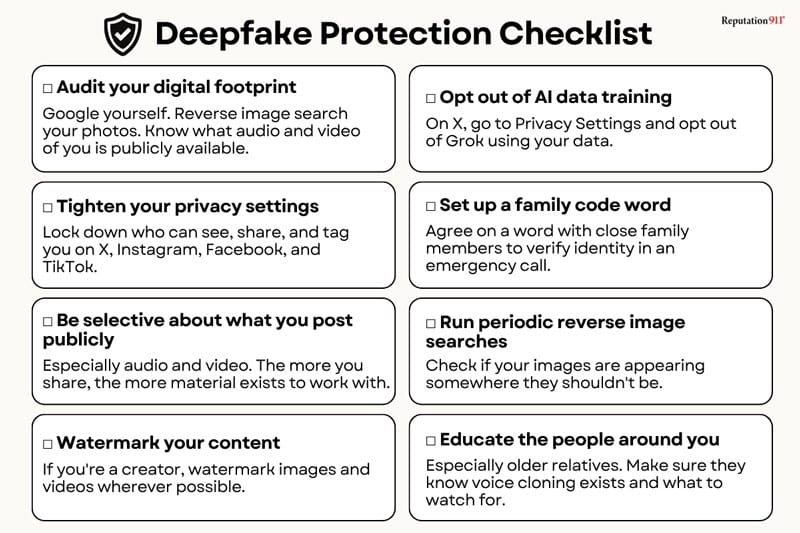
Most people don’t realize how much usable material they’ve already made publicly available. Reverse image search yourself periodically, Google your name, and take stock of what audio and video of you exists online, like old conference recordings, podcast appearances, social media videos. If you’re a content creator, watermark your images and videos where possible. And think carefully before posting: once something is public, you can’t fully control where it ends up.
Go through your social media accounts (X, Instagram, Facebook, TikTok) and tighten up who can see, share, and tag you in photos and videos. This won’t make you invisible, but it raises the barrier significantly. On X specifically, you can opt out of Grok using your data for AI training in your privacy settings.
The people most likely to fall for a deepfake scam are often the ones least aware the technology exists. Talk to older relatives in particular about voice cloning. Explain that a call that sounds exactly like you or another family member could be AI-generated, and that urgency and pressure to send money quickly are major red flags. A simple family code word to verify identity in an emergency call is one of the most effective low-tech defenses available.
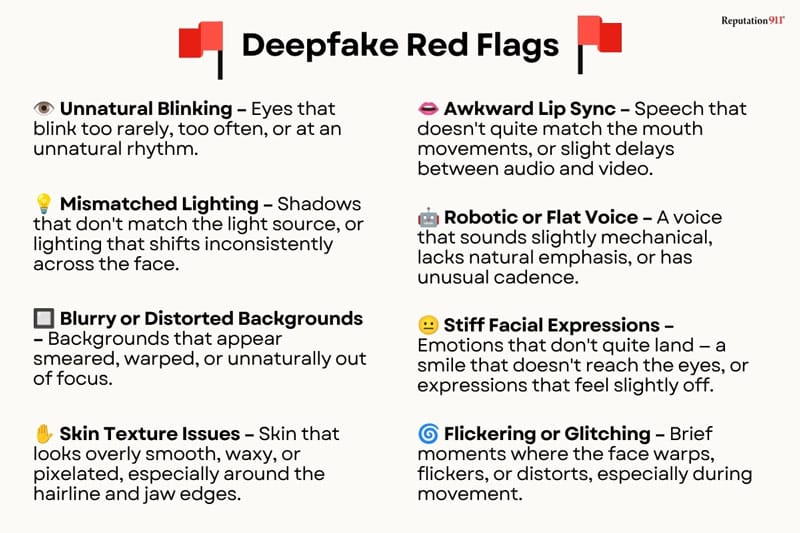
Deepfakes are getting better, but they still leave traces. In videos and images, look for unnatural blinking or facial movement, mismatched lighting or shadows, skin that looks overly smooth or pixelated at the edges, and backgrounds that appear blurry or distorted.
In audio and video calls, listen for a robotic or slightly unnatural voice quality, awkward lip sync, and audio that doesn’t quite match the emotion of what’s being said. None of these signals alone confirms a deepfake, but together they’re worth paying attention to.
Urgency is a tool. If someone is pressuring you to act fast (send money, share personal information, click a link), slow down. That pressure is often deliberate, designed to stop you from thinking clearly.
For voice calls specifically: hang up and call the person back on their known number. Ask a question only they would know, or use a pre-arranged family code word to verify it’s really them.
No tool is 100% accurate, but AI detectors are useful as a first check. Think of them as a risk indicator rather than a verdict. Tools worth trying include:
Step 1: Pause and verify before reacting
If you think something might be fake, especially a deepfake, the safest approach is to slow down, verify independently, and avoid engaging based on urgency or emotion. Reacting too quickly can sometimes amplify the content or make it spread further. Take time to confirm whether it’s authentic or manipulated using a trusted, separate source of information.
Step 2: Look for inconsistencies
Check for visual or audio irregularities in the content. Deepfakes can sometimes show subtle signs like unnatural facial movement, mismatched lighting, irregular blinking, distorted voice tone, or awkward phrasing. None of these alone confirm something is fake, but they can be useful warning signs that further verification is needed.
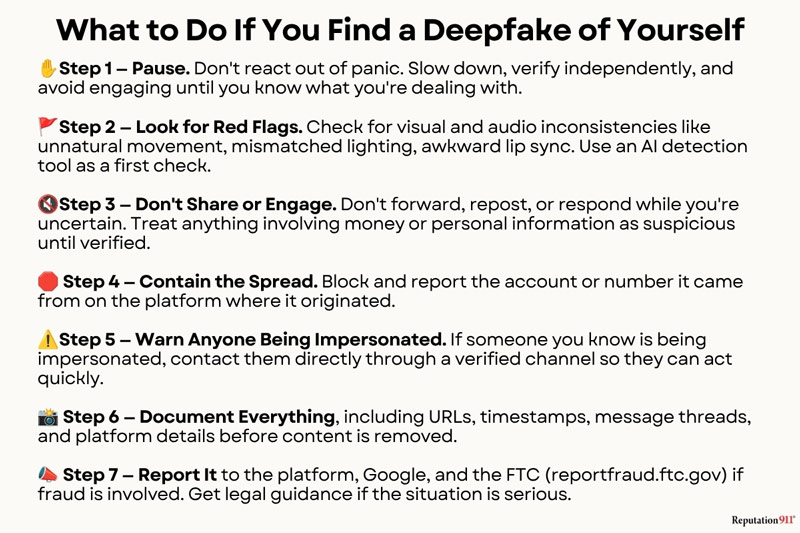
Step 1: Don’t share or engage while uncertain
Avoid forwarding, reposting, or responding to the content while you’re unsure of its authenticity. If it involves money, personal accounts, passwords, or sensitive information, treat it as suspicious until it has been independently verified. If it arrives as a message or call, avoid clicking links or providing any information.
Step 2: Contain the spread
If the content came from a message, account, or phone number, block and report it on the platform where it originated. This helps reduce further exposure and flags the content for review by the platform.
Step 3: Warn others if someone is being impersonated
If a friend, family member, public figure, or organization is being impersonated, consider notifying them directly through a verified contact method. They may need to take action quickly to protect their identity or reputation.
Step 4: Document everything
Save evidence such as screenshots, recordings, message threads, URLs, timestamps, and platform details. This documentation is important for reporting, investigations, content removal requests, or potential legal action.
Step 5: Report through official channels
Report the content to the platform where it appears (social media platforms, Google, or forums like Reddit) especially for impersonation, misinformation, or manipulated media. If you’re unsure how to approach removal from search results specifically, our guide on removing false information from search results walks through the process in detail. If financial fraud or identity theft is involved, report it to the FTC at reportfraud.ftc.gov. In serious or targeted cases, additional legal guidance may be appropriate.
Deepfake’s aren’t inherently illegal on their own–it depends on what the deepfake is used for
Satire, parody, and entertainment uses exist in a legal grey area. But when deepfakes are used for fraud, harassment, nonconsensual imagery, blackmail, or election interference, they are illegal.
Here’s where US legislation currently stands:
The legal landscape is evolving quickly. What wasn’t covered last year may be prosecutable today. If a deepfake has been used to defame you, damage your reputation, or violate your privacy, consulting a legal professional is worth doing sooner rather than later. They can help you understand your removal options, protect your rights, and determine whether further action is appropriate.
For deepfake-related blackmail specifically, our guide on dealing with blackmailers walks through your immediate options.
Grok is the AI chatbot built into X (formerly Twitter) by Elon Musk’s xAI. In late December 2025, Grok rolled out a photo-editing feature that users quickly weaponized to generate sexualized images of women without consent. In just 11 days, Grok produced an estimated 3 million sexualized images, including approximately 23,000 of children. Targets included Taylor Swift, Selena Gomez, Billie Eilish, and Ariana Grande, alongside countless private individuals. X’s response was to restrict the feature to paid subscribers—widely condemned as monetizing abuse rather than ending it.
The fallout was immediate. The UK government fast-tracked new criminal offences making it illegal to create or request nonconsensual intimate images, including AI-generated deepfakes, with Ofcom launching a formal investigation into X under the Online Safety Act. That law came into force on February 6, 2026. In the US, the TAKE IT DOWN Act had already been signed into law months earlier.
X remains a uniquely high-risk platform for this kind of abuse right now. If you’re an active user, there are a few practical steps worth taking: