


A+ BBB Rating

5/5 Rating

5/5 Rating
Leaked Snapchats are private Snapchat images, videos, or messages that have been saved and shared without your consent. Despite Snapchat’s disappearing feature, content can be captured through screenshots, screen recordings, or hacked accounts and redistributed to third-party websites, Telegram channels, and Google search results within hours.
If this has happened to you or your teen, you’re likely feeling scared and overwhelmed. But here’s the good news: removal is possible.
Take these steps right away to remove leaked snapchats online:
This guide covers every step, including reporting to Snapchat, filing DMCA takedowns, Google NCII deindexing, and Telegram removal requests. If you’d rather have professionals handle it, Reputation911’s team has been doing exactly that since 2010.
Key Points
Yes, and in some cases, it’s a serious criminal offense. Sharing explicit images of anyone under 18 is a federal crime, full stop. For adults, non-consensual sharing can violate state revenge porn laws, privacy rights, or defamation statutes. It also violates Snapchat’s community guidelines, which can result in account suspension or permanent removal. If someone is using the content to threaten or extort you, that’s blackmail, which is also a crime.

When you discover leaked Snapchat images, act quickly, but stay calm. Each step below will help you take control, remove the content, and protect your privacy.
If anyone under 18 is involved, contact law enforcement before taking any other steps. Sharing, viewing, or possessing explicit material of a minor is a criminal offense — the police or the National Center for Missing & Exploited Children’s CyberTipline can act immediately.
Before reporting, removing, or confronting anyone, collect evidence of the leak. You’ll need it.
Don’t confront anyone you suspect. It escalates the situation and can compromise a future investigation.
If you’re an adult and were an adult in the images, run a Google reverse image search to find which websites are hosting your content. Also review your Snapchat account activity for any suspicious logins that might explain how the leak happened.
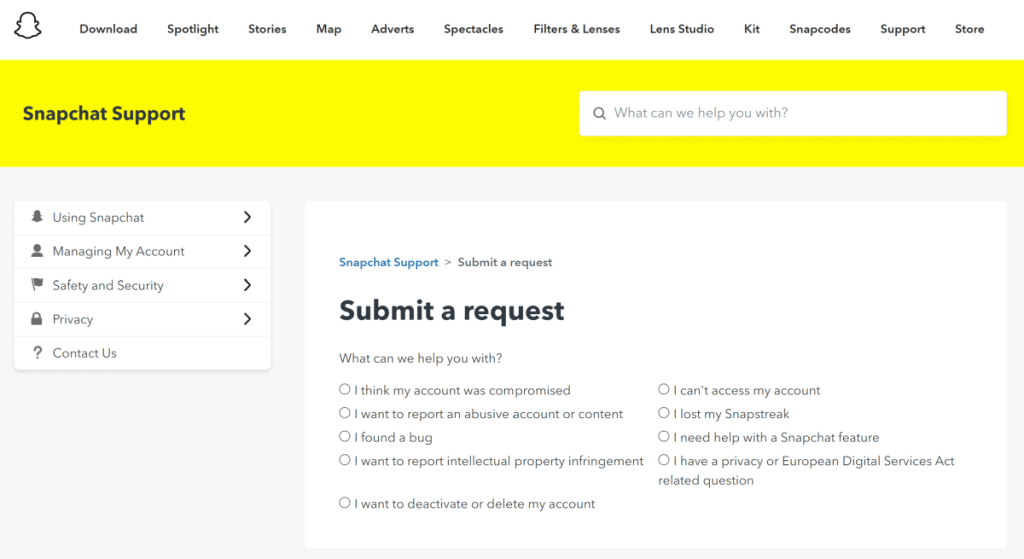
Report the content through the app or Snapchat’s support website as soon as possible. This addresses the content still on the platform.
Use your reverse image search results to identify every site hosting your content, then contact each one directly requesting removal. A DMCA takedown notice is typically the fastest and most effective route.
If you need a hand, our guide on how to remove something from the internet walks through contacting site owners and filing takedowns step by step.
Even after a website removes your content, it can still appear in Google results. File a Google NCII removal request — this can run in parallel with your website takedowns, not just as a fallback after they’re complete. Our guide on removing images from Google walks through the Personal Information Removal Request process directly.
Leaked content can resurface weeks or even months after the initial removal. Stay proactive.
This documentation is helpful if you need to take legal action or file follow-up takedowns later on.
You don’t have to navigate this alone. If the removal process feels overwhelming, the content keeps resurfacing, or someone is using your images to threaten or extort you, professional help is available.
Reputation911’s team handles DMCA submissions, removal requests, Google deindexing, StopNCII enrollment, and ongoing monitoring. Reach out here for a free, confidential consultation.
The professionals at Reputation911 specialize in the takedown and monitoring of leaked images, guiding through the process, ensuring the images are taken down for good.
There’s no single fix. Different platforms require different processes, and most cases require several running simultaneously.
Addresses content still on the platform — a Snap, Story, or account. But this doesn’t address copies already saved and redistributed elsewhere, which by the time most people discover a leak, is most of the problem.
The most direct tool for content hosted on websites. You hold copyright to images of yourself, which gives you legal standing to request removal from hosting platforms. Learn how to properly file a DMCA notice, which requires a faster response than a general contact request — but only from hosts operating within US jurisdiction. Offshore hosts frequently ignore them, which is where Google deindexing and StopNCII become the more reliable routes.
A DMCA notice sent to a web host does nothing for content circulating in Telegram channels. Telegram requires its own separate process — and options are limited to publicly accessible channels and groups. Private chats cannot be moderated or removed by Telegram under any circumstances.
For public channels, you have two routes:
In-app reporting: Open the offending channel or message, tap the three-dot menu, select Report, and choose the relevant violation reason (pornography, illegal content, etc.).
Email takedown requests:
Google NCII Deindexing removes URLs containing your intimate images from Google search results. Runs independently of source removal – you don’t need to wait for a website to comply before filing. Won’t delete content from the hosting site, but makes it significantly harder to find.
Creates a digital fingerprint of your images that participating platforms use to automatically block re-uploads. Free, anonymous, and runs alongside everything else. Adults 18+ enroll at stopncii.org. For minors, use TakeItDown.ncmec.org.
Most people assume leaked Snapchats end up on a handful of websites that can be tracked down and taken down. The reality is messier, and it spreads far. Once private content leaves snapchat, it rarely stays in one place.
Telegram is one of the primary networks through which leaked Snapchat content spreads. It’s also one of the hardest to address. Content circulates inside private group channels that don’t appear in Google search results, meaning most victims don’t know their images are there, and most standard removal tools don’t reach them.
Be cautious of any company claiming they can remove content from private Telegram groups. Telegram functions more like a private messaging network than a public website. Once content is inside a private channel, removal options are extremely limited.
What is possible is monitoring: tracking whether content resurfaces on public-facing platforms or new channels, and acting quickly when it does.
Snapchat notifies you when someone screenshots your content — but it can’t stop them. A second device pointed at your screen leaves no trace. Screen recording apps can capture disappearing content before the timer runs out. Third-party apps have historically saved Snaps without triggering any alert at all.
Once saved, content can go anywhere: texted, posted to forums, uploaded to image-sharing sites, or dropped into private channels.
Some leaks come from compromised accounts. Hackers pose as Snapchat support, trick users into handing over verification codes, and gain full account access including My Eyes Only. It’s become common enough that the FBI maintains an active reporting form specifically for this scheme.
Phishing messages are designed to look legitimate — a login alert, an account suspension warning, a verification request. If your account has been accessed this way, act immediately: change your password, enable two-factor authentication, and review your login history for unfamiliar activity.
Yes, and more often than most people expect. A leak frequently becomes leverage — someone gets hold of your images and makes contact demanding money, more content, or favors, threatening to send the content to your contacts or post it publicly if you don’t comply. This is sextortion, and paying almost never makes it stop.
If you’re already receiving threats, content removal alone isn’t enough. Our guide on how to deal with blackmailers covers exactly what to do.
If explicit images of your child are circulating online, report it to law enforcement before you do anything else. Contact your local police, the NCMEC CyberTipline (1-800-843-5678), or the Know2Protect Tipline (833-591-KNOW). Sharing, possessing, or distributing explicit images of anyone under 18 is a federal crime regardless of how the content was originally shared.
Once you’ve reported, use TakeItDown, a free NCMEC service that creates a digital fingerprint of your child’s images directly on your device without anyone viewing them. That fingerprint gets shared with participating platforms, which automatically detect and block re-uploads of the same content. It’s anonymous, it’s free, and it works alongside the reporting and removal steps covered earlier in this guide.
Yes. Two incidents stand out.
In 2013–2014, a vulnerability in Snapchat’s “Find Friends” feature allowed attackers to harvest the usernames and phone numbers of approximately 4.6 million users through third-party apps and API misuse. Snapchat’s servers weren’t directly breached, but the exposure was significant enough to prompt major security overhauls including rate limiting and two-factor authentication.
In 2019, the threat came from inside. Snapchat employees were found to have misused an internal tool called SnapLion — built for legitimate law enforcement requests — to access private user data including messages, location information, and phone numbers without authorization.
No platform has absolute security, and exposure can come from directions you’d never anticipate.
Snapchat’s disappearing feature won’t necessarily protect you. Screenshots, screen recordings, second-device photography, and third-party apps can all capture a Snap before it disappears, and once saved, that content can go anywhere. For teens especially, the false sense of security the platform creates is itself a risk.
These settings won’t eliminate that risk, but they significantly reduce your exposure:
No setting protects you from a person who’s determined to save what they see. The most reliable protection is being deliberate about what you send and who you send it to.

In many cases, yes. DMCA takedowns, Google NCII deindexing, and StopNCII enrollment together cover most distribution channels. Fast action significantly improves outcomes — but copies can resurface, which is why ongoing monitoring matters alongside removal.
You don’t need their cooperation. DMCA notices go directly to the hosting platform, not the person who posted the content. Google NCII deindexing removes URLs from search results regardless of whether the site complies. If threats or extortion are involved, that’s a separate criminal matter, and you should contact law enforcement.
A free hash-matching tool for adults 18 and over. It creates a digital fingerprint of your images on your device — without uploading them — and shares that fingerprint with participating platforms so they can automatically detect and block re-uploads. Enroll at stopncii.org. For anyone under 18, use TakeItDown.ncmec.org instead.
Private Telegram groups fall outside what any removal process can reach, as Telegram does not moderate private chats. What’s possible is monitoring public channels for redistribution and acting quickly if content moves onto the open web. Be cautious of any service claiming otherwise.
No. DMCA takedowns, Google NCII requests, and StopNCII enrollment are all private processes. Your identity and the content itself are not published as part of any removal request.
Google NCII deindexing typically processes within a few days to a few weeks. DMCA takedowns to compliant hosts average 5–10 business days. Telegram and offshore sites are less predictable. Some content comes down quickly. Other cases require sustained effort over weeks or months, particularly when content keeps resurfacing on new platforms.