


In today’s fast-moving digital world, a company’s reputation can be impacted in an instant. Even a single widely publicized mistake can trigger a reputation crisis. If not handled quickly and carefully, it can severely damage your brand.
In the short term, you may experience stress and anxiety. In the long term, a tarnished brand reputation makes it harder to attract new clients and in some cases, may take years to fully rebuild, even more than any decline in revenue.
If you feel helpless and pressured to respond immediately, the key is to stay calm and follow a structured approach. Keep reading this guide for a step-by-step approach to handling a reputation crisis for your business.
Quick tips:
Fast, thoughtful action limit damage and prevent negative narratives spreading.
Clear, honest updates build trust and reduce speculation during uncertainty
Owning mistakes and fixing root causes restores credibility faster
Unified messaging avoids confusion and reinforces professionalism and trust.
Track perception, evaluate lessons, and implement long-term improvements.
A business reputation crisis occurs when an event, allegation, or narrative spreads quickly and significantly damages public trust, credibility, or confidence in a company’s brand (regardless of whether the information is true or false).
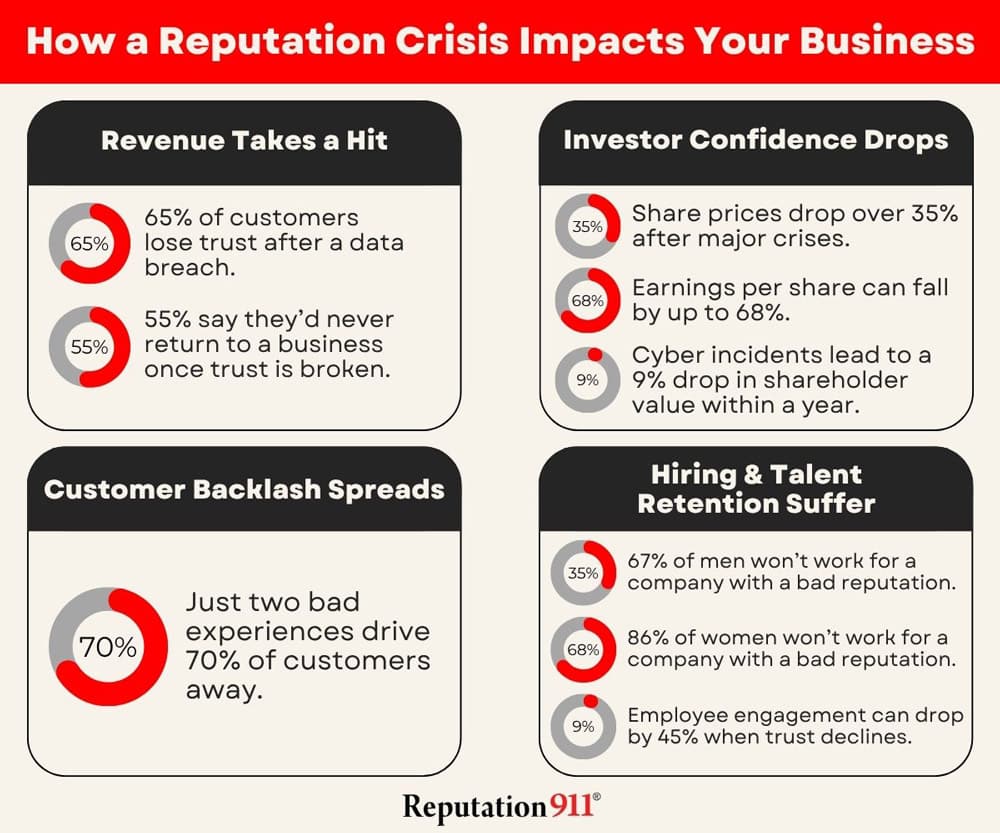
The reputational damage that comes from these crises can translate directly into a loss of income, according to 86% of companies.
Key factors that determine the severity include:
A reputation crisis can have immediate and long-term consequences for a business. Beyond lost revenue, companies often face declining customer loyalty, reduced conversion rates, higher customer acquisition costs, and increased scrutiny from regulators, partners, and investors. Internally, reputation damage can erode employee morale, hinder hiring efforts, and distract leadership from core operations—turning a public perception issue into a full-scale business risk.
What does a business reputation crisis look like? Here are a few common examples:
Crisis Type | Description |
Customer & Public-Facing Crises | A public customer complaint or service failure spreads quickly and damages trust. |
Employee & Workplace Issues | Employee misconduct or workplace allegations draw public scrutiny. |
Leadership & Executive Crises | Executive behavior or statements trigger backlash against the company. |
Legal & Compliance Issues | Lawsuits or regulatory violations raise ethical concerns. |
Data, Technology & Security Incidents | Breaches or outages expose vulnerabilities and erode confidence. |
Social, Cultural & Ethical Crises | Messaging or practices are seen as insensitive or unethical. |
Media & Public Relations Crises | Negative coverage or misinformation drives a harmful narrative. |
Operational & Business Failures | Disruptions like layoffs or closures impact stakeholders. |
Online Review Crises | A surge of negative reviews damages credibility and visibility. |
Partner & Third-Party Crises | Partner misconduct reflects poorly on your brand. |
When a reputation crisis hits, the way you respond in the first hours and days can make all the difference. Acting thoughtfully and strategically helps limit harm, maintain trust, and set the stage for recovery.
Timing is so critical in instances of a reputation crisis. Responding swiftly shows stakeholders that you take the situation seriously and are committed to resolving it. Delayed reactions allow rumors and negative narratives to spread, making recovery more difficult.
Honest, clear communication builds trust during a crisis. Share what you know, what steps are being taken, and when stakeholders can expect updates. Transparency reduces uncertainty and prevents speculation from filling the information void.
If your business is at fault, acknowledging mistakes demonstrates integrity and accountability. Avoid shifting blame or making excuses, as these behaviors erode credibility. Taking ownership of a mistake can be the first step to rebuilding trust with customers, employees, and investors.
A consistent, credible voice is essential to avoid confusion and mixed messaging. The spokesperson should be trained to handle media inquiries and communicate updates clearly, ensuring your messaging is unified and professional.
Examples of potential spokespeople:
Choosing the right spokesperson depends on the type of crisis, the audience, how your business is internally structured, and the desired tone of communication.
To fully recover from a business reputation crisis, employees must be involved and know their role in managing the situation. Keep them informed, provide clear guidance, and empower them to communicate consistently with customers and stakeholders. A well-informed team helps protect your brand and maintain morale.
Track social media, news outlets, and reviews to understand how the crisis is evolving. Monitoring allows you to respond quickly to emerging concerns and adjust your strategy as needed. Staying aware helps prevent surprises and reputational damage.
Address the root cause, whether it’s a product failure, service issue, or leadership problem. Quick and effective solutions prevent recurrence and signal commitment to improvement. Actions speak louder than words when restoring credibility.
Develop a structured strategy to rebuild trust and restore your reputation. This may include public communications, community engagement, or highlighting positive changes. A clear plan demonstrates proactivity and long-term commitment.
After the crisis, conduct a thorough review to understand what went wrong and how it was handled. Use these lessons to strengthen policies, crisis response plans, and internal processes. Continuous learning reduces the risk of future crises.
After a business misstep triggers a reputation crisis, the response phase is not the time to compound the problem. Even well-intentioned businesses can make decisions that unintentionally worsen the situation.
Even well-intentioned businesses can make missteps during a reputation crisis that unintentionally make the situation worse. Being aware of these common mistakes can help you respond more effectively, protect your credibility, and reduce long-term damage.
When it comes to handling a business reputation crisis effectively, a crisis response plan is critical. Without a plan, your team may react inconsistently or inefficiently, worsening the situation.
Only 49% of companies have a formalized crisis response plan, so having one in place gives you a strategic advantage.
Being prepared for a crisis ensures clarity, accountability, and speed when a crisis arises. No crisis is going to be a smooth experience, but having a plan in place helps mitigate the damage of an issue right from the start.
Pretending the issue isn’t a big deal allows it to escalate over time. Silence can be interpreted as negligence or a lack of accountability.
Instead, it’s important to get ahead of the issue. This allows you to control the narrative, demonstrate responsibility, and reassure stakeholders that the business is actively addressing the problem. Acting early also helps limit damage, prevent rumors from spreading, and set the stage for a smoother recovery.
Waiting too long to respond gives negative narratives time to spread. Quick action demonstrates responsibility and helps control the story.
One study even found that organizations who responded within the first hour of a crisis experienced 21% less reputation damage than those that waited longer. Every hour counts.
Blaming others undermines credibility and erodes stakeholder trust. Owning mistakes and showing a commitment to correction is far more effective. It’s the first step to rebuilding trust with consumers.
Conflicting statements create confusion and damage reputation. To address a business reputation crisis effectively, your team must be a unified front. Ensure all team members know what to say and follow a consistent communication strategy.
Addressing only surface problems leaves the business vulnerable to repeat crises. Root cause solutions demonstrate genuine improvement.
Jumping straight to “business as usual” ignores important lessons and risks repeating mistakes. It’s like skipping therapy and expecting old wounds to heal on their own. Without understanding and addressing the underlying issues, the same problems are likely to resurface.
Take time to evaluate the crisis, reflect on what went wrong, and implement long-term safeguards to strengthen your business moving forward.
Don’t wait. Work with an experienced agency to address your reputation crisis.
This effort will take time. It doesn’t happen overnight, but being consistent with your messaging will help your brand recover.
The time to fully recover from a business crisis can vary. Some crises resolve in days, others take weeks or months depending on severity, response quality, and public perception. Recovery often requires sustained communication and demonstrable corrective action.
Communicate with employees and brand stakeholders so they understand their role in rebuilding trust and maintaining standards.
Highlight positive changes to share improvements, success stories, and community contributions, helping restore confidence.
The positive content will help push down negative content on Google and other search engines. This is a tactic used in reputation management called search engine suppression – if negative content cannot be removed, positive content can be used to push it down.
Monitor social media, reviews, and news coverage to respond quickly to lingering concerns and ensure your recovery efforts are effective.
Proactively monitoring your business, engaging stakeholders, and learning from past mistakes helps safeguard your reputation. If there’s anything to take away, it’s:
At Reputation911, we work fast to develop proactive strategies, manage crises effectively, and rebuild your brand’s credibility so your business is stronger and more resilient than ever.
By suppressing and removing negative articles and other content, and through comprehensive reputation management, we help businesses protect their image, maintain stakeholder confidence, and position themselves for long-term success.
When negative news coverage, reviews, or social media activity threatens your business, a fast, strategic response matters. Reputation911 provides crisis reputation management, specializing in content removal, suppression, and brand recovery—so you can stabilize your reputation, regain trust, and move forward with confidence.
Reputation crises are easier to understand and learn from when you see how they play out in real life.

In 2025, major UK supermarkets Marks & Spencer (M&S) and Co-Op were hit by a ransomware attack that took down contactless payments, disrupted online orders, and left store shelves empty.
M&S Response:
Marks & Spencer halted online orders and issued refunds to affected customers. While the company began preparing a cyber insurance claim, delays in resolving technical issues and unclear public messaging led to growing frustration.
Customers were left confused and dissatisfied, and the incident reportedly reduced the company’s market value by over £1 billion. M&S faced ongoing operational challenges for weeks and struggled to regain control of its ordering systems.
Co-Op Response:
Co-Op faced the same attack but responded more quickly. They restored systems faster, communicated updates clearly, and were able to recover operations ahead of M&S. As a result, Co-Op avoided some of the deeper fallout M&S experienced.
Key Lessons:
Sources:

In July 2024, Delta Air Lines suffered a major crisis when a flawed software update from CrowdStrike crashed systems worldwide.
While other airlines recovered quickly, Delta canceled around 7,000 flights, stranding 1.3 million passengers and prolonging disruptions for nearly a week. The crisis cost Delta an estimated $550 million, and triggered a U.S. Department of Transportation investigation into how it handled passenger rights during the chaos.
Delta’s Response:
Delta apologized and offered compensation and travel waivers, but many passengers complained about poor communication, long customer service waits, and delayed refunds.
Frustrations led to a proposed class action lawsuit, accusing Delta of denying full refunds unless customers waived legal claims. One couple missed a $10,000 anniversary cruise, receiving only $219.45 in compensation, while another passenger spent €5,000 ($5,685) due to a canceled flight and delayed luggage, but was offered just €588 ($669).
A federal judge allowed parts of the lawsuit to move forward, including claims under the Montreal Convention for international flight disruptions.
Key Lessons:
Source:

Once an iconic Park Avenue wine retailer, Sherry-Lehmann collapsed in 2023 after losing its liquor license and facing accusations of undelivered wine and missing bottles from its storage facility.
The business owed millions in debts and was raided multiple times by the FBI and other agencies.
In 2025, current owners Kris Green and Shyda Gilmer sued former owners and a New York Times journalist, alleging a smear campaign that fueled law enforcement raids and derailed a $20 million merger, though those accused have denied wrongdoing.
Sherry-Lehmann’s Response:
Sherry-Lehmann’s current owners denied running a “Ponzi scheme,” blaming the business’s troubles on debts left by prior owners and damaging media coverage that scuttled a $20 million sale to a French vineyard group. They filed a RICO lawsuit to clear their name and seek damages, though no indictments or arrests have followed the investigations so far.
Key Lessons:
Sources:
